
 Global
Concept of sustainability
Basic Concept
Driving Sustainability for our Future
The mission and vision of the Ricoh Group are as follows: "At Ricoh, we empower individuals to find fulfillment through work by understanding and transforming how people work by unleashing their potential and creativity to realize a sustainable future." This mission is based on our founding principles “The Spirit of Three Loves” — Love your neighbor, Love your country, Love your work (, which was formulated in 1946 by our founder Kiyoshi Ichimura) . We are actively engaged in various initiatives aligned with our sustainability message, "Driving Sustainability for Our Future."
Building on this foundation, we express our vision for a sustainable society as the “Three Ps Balance,” where Prosperity (economy), People (society), and Planet (environment) are harmoniously balanced. With the aim of realizing a society that continues to develop while maintaining this balance, we became an environmental management pioneer in 1998. Since then, we have pursued both environmental conservation and profitability. Further advancing these efforts, we have adopted a policy of aligning ESG with business growth, integrating ESG and SDGs initiatives into our core management strategies and systems. Building on these efforts, we are striving to become a global ESG leader by driving initiatives across our entire value chain.
Under the Mid-Term Management Strategy ’26, we have established key goals (KGIs) to be achieved by 2030 for each of the three areas of the “Three Ps Balance.” Furthermore, in order to enhance corporate value and contribute to the Three Ps Balance, we have identified six material issues, considering social and customer expectations as well as our mid-term management strategy.
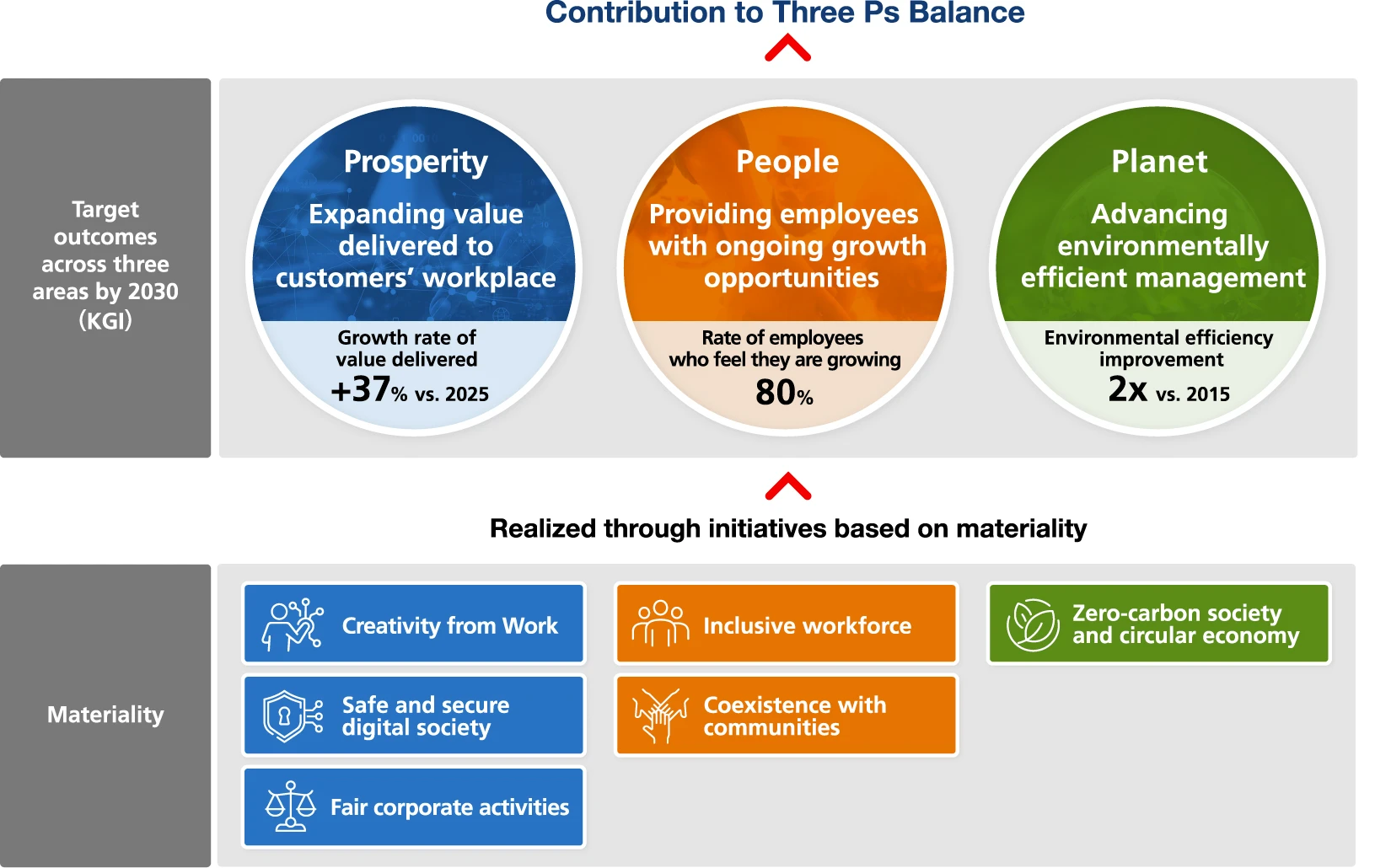
 Materiality for the Ricoh Group
Sustainability Promotion Framework
To ensure continuous management-level discussions on ESG issues, we have established an oversight structure through the Board of Directors and an execution framework centered on the ESG Committee as a decision-making body.
<Diagram of the Sustainability Promotion Framework>
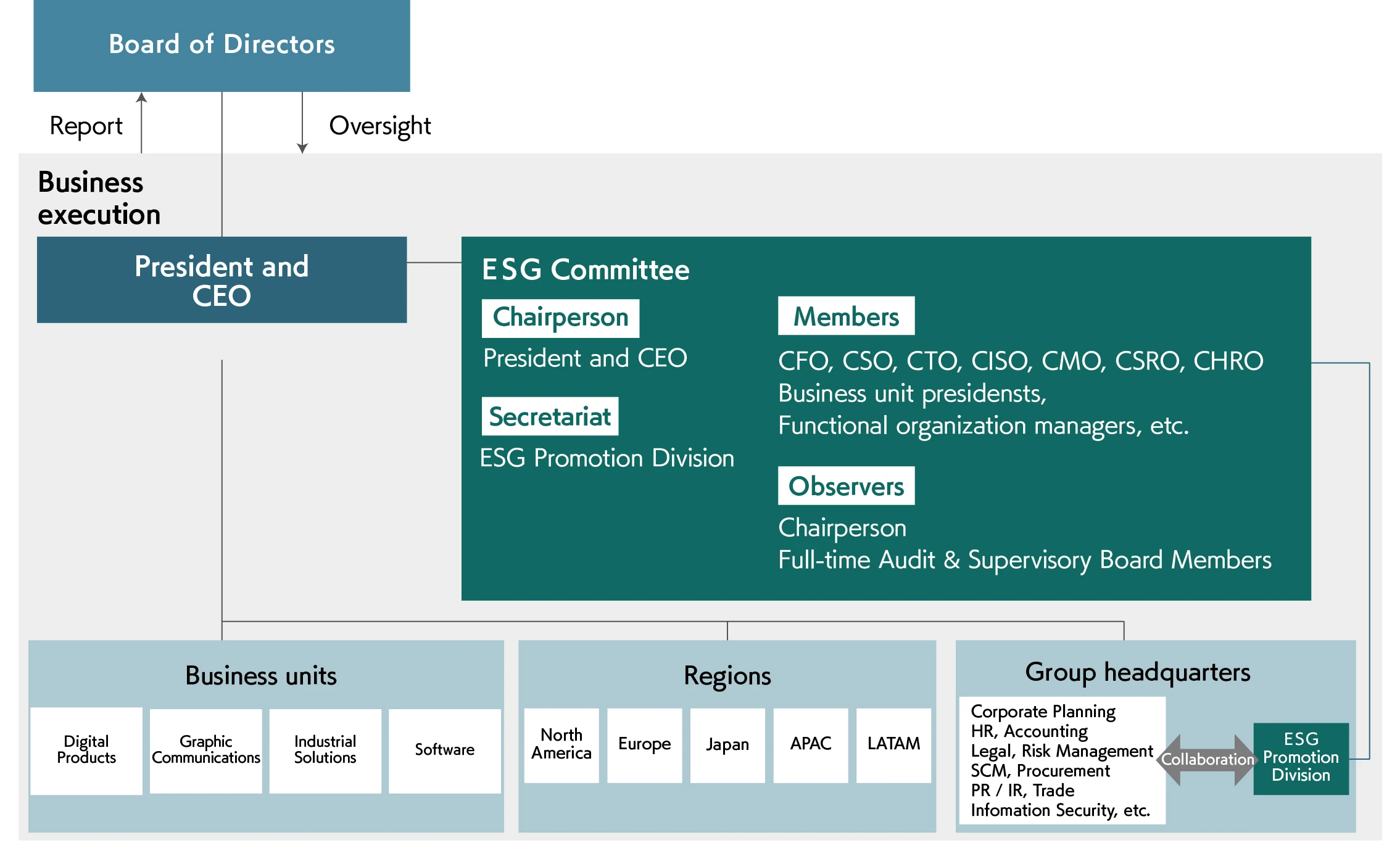
LATAM: Latin America
<Oversight structure>
The Board of Directors determines the Company’s material social issues (materiality), taking into account sustainability-related risks and opportunities, and approves and oversees the execution of ESG policies and business plans. The Board also monitors, supervises, and advises on management risks and opportunities in line with our oversight structure.
<Executive structure>
The ESG Committee is a decision-making body chaired by the CEO and meets quarterly. From fiscal 2026, it has consisted of the CFO, CSO, CTO, CISO, CMO, CSRO*, CHRO, business unit presidents, and heads of functional organizations. The Chairman of the Board and full-time Audit & Supervisory Board Members attend the ESG Committee as observers. The ESG Committee deliberates on future business risks and opportunities in sustainability, the identification of material social issues (materiality), the setting of ESG targets, and investments in renewable energy, among other matters. Important matters are determined subject to the approval of the Board of Directors
Key ESG themes, including decisions made by the ESG Committee, are incorporated into specific targets and measures for each functional organization and business unit, and the ESG Committee regularly reviews the progress of these targets and measures.
* CSRO:Chief Sustainability & Risk Management Officer
Role of the ESG Committee
- Supervise and advise on ESG strategy formulation, material issues, and progress in KPIs for each business division throughout the entire Group
- Identify medium- to long-term ESG risks and opportunities as well as material issues faced by the entire Group
- Identify ESG issues to be submitted for discussion at the Board of Directors and report them to the Board of Directors
| Fiscal 2025 | Agenda | |
|---|---|---|
| First
Meeting |
May |
|
| Second
Meeting |
August |
|
| Third
Meeting |
November |
|
| Fourth Meeting |
February |
|